

With the current Stay At Home Orders due to COVID-19, many employees are now working from home. As of March 2020 nearly 90% of organizations have recommended or required employees to work from home.
There can be many positives working from home such as no commute time, flexibility of schedule, more time with family, less office distractions, and casual Friday dress everyday. 
However, with everyone working from home and a limited ability to go outside, people are spending more and more time sitting. Increased sitting as we all know can have a dramatic effect on posture and health. With the increase in sitting combined with increase in stress levels due to the financial and social impact of the Pandemic, neck, back, and joint pains are on the rise.
Exercise is a great way to combat postural stress and pain, but you’ve been ordered to limit your exposure out of the house. You can’t go to the gym and you can’t workout at home because you’re limited on space, so can you do?
If you, like many Americans, who can’t or frankly don’t want to exercise, then how do you get rid of this stiff neck or back? A little motivation, education, and time is all that is needed. With postural education, postural strategies, and easy timed simple exercises you can reduce and prevent desk/computer related injuries.
Ergonomics
Ergonomics is defined as the science of fitting a workplace to the person’s needs. Ergonomic goals are to increase efficiency and productivity and reduce worker discomfort.
With the shift to working from home, many employees are not set up to work from home, resulting in bad postural habits and positions.
Proper ergonomics is essential in preventing and treating desk work/computer related symptoms and injuries.
Sitting Posture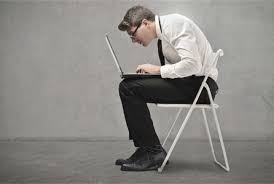
Approximately 80% of the work force will suffer from back pain at one point in their lives. Ergonomic training is critical in assisting workers in avoiding undue back pain.
Sitting in general is tough on the lumbar spine. Sitting in an upright position (proper posture) places approximately 300 pounds of intervertebral disc pressure on the lumbar spine. Sitting in a slouched position increases that disc pressure by more than 25%.
In addition to back pain, slouching while sitting can add pounds of pressure to the neck as well as seen below in the diagram. Research shows that for every inch your head is forward adds 10 pounds of pressure to the cervical spine. Forward head posture can also contribute to shoulder and mid back pain as well.

Standing Desks
Standing desks are great options to brake up the monotony of sitting. Standing places less pressure on the lumbar spine compared to sitting however poor posture and ergonomics in standing for prolonged periods can also have adverse affects.
 Standing in an upright position places approximately 200 pounds of intervertebral disc pressure on the lumbar spine a difference of nearly 100 pounds less as compared to sitting in an upright position. However, standing with poor posture increases that pressure by nearly 40%.
Standing desks also require a proper ergonomic set up in order to assist you in maintaining a proper position as you work. This means your monitor height, keyboard placement, and mouse placement have just as much importance as lumbar and neck posture.
Standing in general is better on the lumbar spine, but a combination of sitting and standing is ultimately the best for overall postural health.
Kids and Gamers
Kids and gamers are notoriously the worst when it comes to proper ergonomics and posture. Most gamers are slouched on the couch, lazy boy, and floor for hours, intently focused and never moving.

Intense and accumulative stress on the spine, shoulders, elbows, wrist, and fingers builds as game play continues. Even with fancy gaming chairs, it’s still difficult to maintain a proper sitting position. Press pause whenever possible. Stand up, before you restart. Do a set of exercises before continuing. Take longer breaks between games. Schedule off-times throughout the day. It’s definitely tough to entertain the kids with everyone stuck at home, but limiting prolonged game play will definitely prevent possible repetitive stress injuries and future postural issues.
Proper Ergonomic Setup
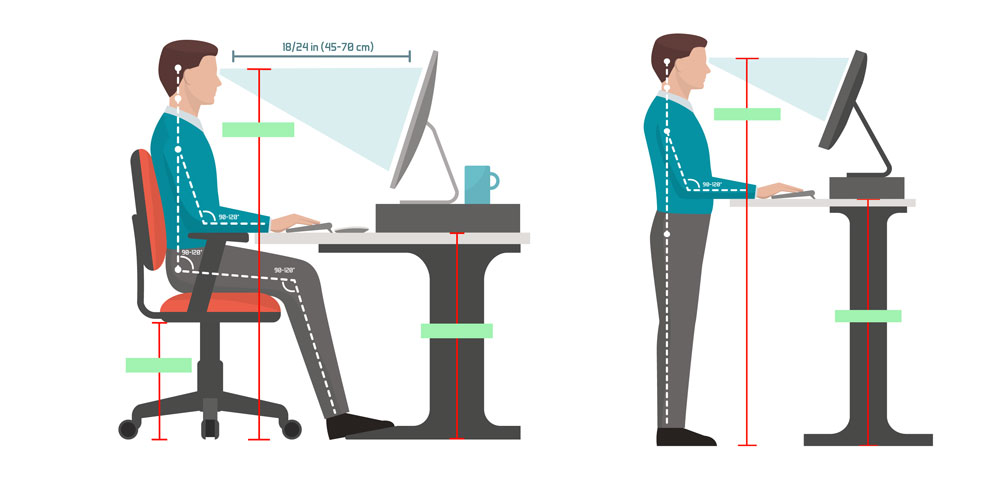
Do your best to address your sitting and standing ergonomics. If you can’t access the necessary equipment needed to attain the ergonomic standards, simple things around the house such as pillows, towels, books, footstools, and may other household items can be used for a makeshift ergonomic set up. The closer you attain sitting and standing positions similar to ergonomic recommendations (see pictures below) the less stress you will put on the body.
- Computer monitor should be slightly below eye level.
- Keyboard and mouse placement should be in a position so your elbows, hips, and shoulders are between 90-120 degrees of flexion.
- Wrists should be as close to neutral (straight) as possible.
Exercise
Yes, exercise is a great way to combat work related and sitting related injuries, but time, motivation, and space tend to be the excuse. It is recommended that adults perform 30 minutes of exercise a day. The recommended 30 minutes does not have to be performed all in one session, it can be accumulative. Exercising for short bouts throughout the day are easy ways to prevent prolonged stagnant positions and to accumulate exercise minutes for overall health as well. Suggestions include:
- Stand up for a minute every 30 minutes
- Walk around the house for a few minutes every hour.
- Simple stretches at or beside your desk a couple times a day
- Join a fitness challenges, recruit your friends and coworkers to help motivate you.
- Pedometers. You can still count your steps walking to the fridge and back to your desk… it counts.
- For those more motivated there are a number of apps and online programs to keep you moving.
Below are some simple exercises you can do sitting or standing to help alleviate spinal stresses created during the work day. Perform one or all every half hour to hour to break up prolonged sitting and standing.


Remember almost anything counts and everything helps when you move in regards to exercising and removing yourself from stressful postural positions. Don’t let your new working condition be the cause of unnecessary stress and strain injuries. Control your environment, take breaks, unlock yourself, press pause, disconnect, and most importantly move.
QUESTIONS?
 The Injury Atlas